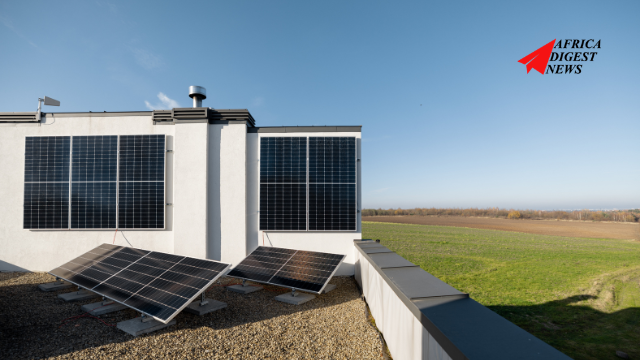
Infinity Power has signed an agreement with solar manufacturer AIKO to supply 773.5 MWp of solar modules for three utility-scale projects in South Africa: Highveld, Onderstepoort Solar 1 and Onderstepoort Solar 2. The projects were awarded under the Renewable Energy Independent Power Producer Procurement Programme’s Bid Window 7 and are planned to sell electricity to Eskom under 20-year power purchase agreements (PPAs). Together, the developments are expected to generate more than 1,871 GWh of electricity annually, adding to South Africa’s planned utility-scale solar capacity.
The supply agreement covers AIKO’s All Back Contact (ABC) modules, a technology that places electrical contacts on the rear of solar cells rather than across their front surfaces. This design reduces the area obscured by front-side contacts, allowing more sunlight to reach the active cell material. For large solar farms, module efficiency can influence how much electricity a project produces from a given area, although the overall financial benefit depends on equipment prices, site conditions, system design and long-term performance.
The three projects form part of South Africa’s effort to procure additional generation through competitive bidding and long-term electricity-sale agreements. Under a 20-year PPA, a project has a defined contractual arrangement for selling its electricity, providing a foundation for revenue projections and financing assessments. The final economics still depend on the terms of the agreements, project costs, construction schedules and the ability to deliver electricity through the grid.
Read Also: Why Solar Power Alone Is Not Solving Africa’s Energy Access Problem
For Infinity Power, securing modules addresses a major equipment requirement across the portfolio, but it does not by itself mean the projects are ready to generate electricity. Financing, engineering, grid connection, construction and commissioning must still progress before the planned capacity becomes operational. The 773.5 MWp figure refers to the combined peak rating of the solar modules being supplied, while the projected annual output of more than 1,871 GWh reflects the electricity the three projects are expected to produce over a year.
The developments also illustrate how South Africa’s renewable-energy procurement process links equipment suppliers, independent power producers and the national utility through projects designed around long-term electricity sales. AIKO’s modules will supply a key component of the three solar farms, while the Eskom PPAs provide the planned route for selling their output. The next milestones will be the projects’ progress towards financing, construction and commercial operation, which will determine when their expected generation can contribute to the country’s electricity supply.


