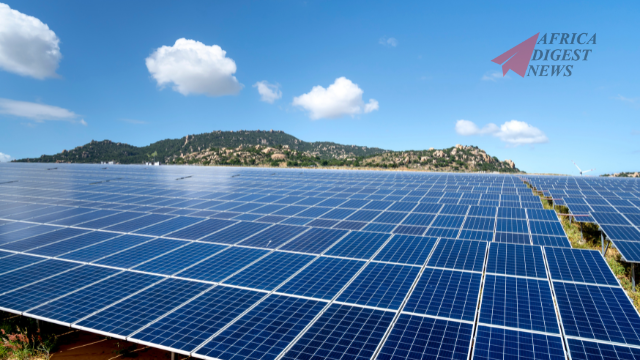
The narrative that Africa is a marginal player in the global energy transition is officially dead. Data from the Africa Solar Outlook 2026 reveals a continent that is not just participating in the solar race but setting the pace. In 2025, Africa recorded a 54% year-on-year increase in solar installations, making it the fastest-growing solar region globally.
The most striking revelation is the gap between documented capacity and reality. While official records show 23.4 GWp of operational solar, a 26% rise from the previous year, international trade data tells a different story.
China, which accounts for 90% of global module exports, shipped approximately 63.9 GWp of solar capacity to African ports by the end of 2025. This suggests that the actual solar footprint on the continent is nearly three times larger than previously estimated. This “hidden” capacity is largely composed of commercial, industrial, and residential systems that bypass formal utility reporting but fundamentally alter the energy balance of national grids.
Capacity and Growth Drivers
The growth is no longer confined to a few utility-scale projects. It is driven by a structural shift in how African economies view energy security. In markets like South Africa and Nigeria, solar is no longer an environmental choice; it is a survival strategy against failing national grids and the volatile cost of diesel.
| Metric | 2024 Status | 2025/2026 Status | Change |
| Documented Capacity | 18.5 GWp | 23.4 GWp | +26% |
| Estimated Actual Capacity | ~45 GWp | 63.9 GWp | +42% |
| Annual Growth Rate | 35% | 54% | +19% |
| Dispatchable Solar Cost | $95/MWh | $76/MWh | -20% |
The economics have reached a tipping point. The cost of converting daytime solar into 24-hour dispatchable power using battery storage has dropped to approximately $33/MWh. When combined with generation costs, the total price of $76/MWh makes solar-plus-storage cheaper than new fossil fuel generation in most African jurisdictions. This is the core truth of the 2026 market: solar is now the default economic choice for baseload power.
Investment Hotspots
Investment is concentrating in three distinct tiers. The first tier includes established giants like South Africa, which added 1.6 GW in 2025 alone, and Egypt, which continues to expand its utility-scale footprint. The second tier consists of growth engines like Nigeria, where 803 MW of new capacity was added last year, primarily in the commercial and industrial (C&I) sectors.
Read Also: Africa’s Dual Energy Transition Faces Funding Mismatch: 82% of Finance Skews to Utility-Scale
The third tier, the true hotspots for 2026 includes countries like Namibia, Botswana, and Chad. These nations are seeing the strongest upward movement in solar capacity per capita. Namibia, in particular, is leveraging its high solar irradiance to position itself as a regional green energy hub.
The focus is shifting from merely installing panels to managing complex, storage-integrated systems. Those waiting for more favorable conditions are already behind. The infrastructure is being built now, often off the books, and it is redefining the continent’s economic trajectory.
The rise of regional power pools, such as the Southern African Power Pool (SAPP), is beginning to facilitate the cross-border trade of solar energy. This means that a solar farm in Namibia could soon be powering a factory in Zambia, creating a more resilient and integrated continental grid.
This regional integration represents the next frontier of growth, moving beyond national borders to create a truly pan-African energy market. The state of solar in 2026 is one of aggressive expansion, technical maturity, and undeniable economic dominance. The transition is no longer a future projection; it is the current reality of African industry.
By Thuita Gatero, Managing Editor, Africa Digest News. He specializes in conversations around data centers, AI, cloud infrastructure, and energy.