In 2025, the continent added 4.5 gigawatts of new solar capacity, a 54% increase from the previous year and this growth is forcing governments to update their regulatory frameworks.
For installers, contractors, and solar companies, understanding these new regulations is a prerequisite for operating legally and competitively. This article outlines the critical regulatory changes across Africa in 2026 that will directly impact your business.
The Regulatory Landscape: A Continent in Motion
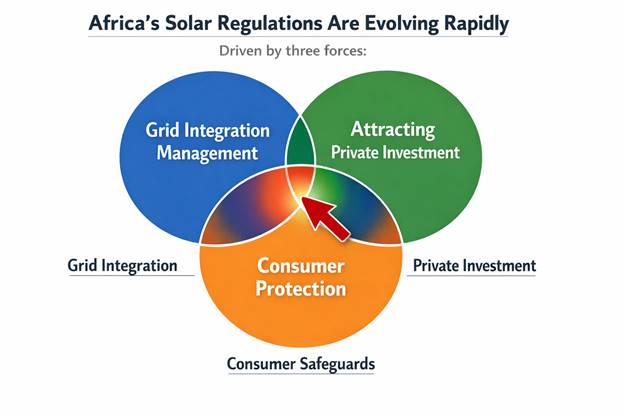
Africa’s solar regulations are evolving rapidly, driven by three forces: the need to manage grid integration, the desire to attract private investment, and pressure to ensure consumer protection.
Unlike the developed world, where regulations have been stable for years, African countries are still establishing their foundational frameworks.
This creates both opportunity and risk for installers. The opportunity lies in early-mover advantage; the risk lies in non-compliance.
Kenya: Net Metering and Grid Integration
Kenya’s Energy and Petroleum Regulatory Authority (EPRA) has finalized the Net-Metering Regulations, which took effect in 2024 and continue to evolve in 2026. This regulation allows consumers to feed excess solar energy back into the grid and receive credits. For installers, this means understanding the technical requirements for grid-tied systems.
The key requirements are straightforward but non-negotiable. All grid-connected solar systems must be equipped with bidirectional meters that can measure both energy drawn from and fed into the grid.
The system must include automatic disconnection devices to protect utility workers during grid maintenance. Installers must register all systems with EPRA and the local distribution utility. Failure to comply can result in system disconnection and fines.
More importantly, the Net-Metering Regulations apply to renewable energy technologies including solar, wind, hydro, geothermal, and ocean energy. This creates an opportunity for installers to diversify beyond pure solar into hybrid systems. However, it also means that installers must stay current with regulations that may evolve to include new technologies.
South Africa: Tax Incentives and Section 12L
South Africa’s renewable energy tax incentive, known as Section 12L, provides a 125% deduction for renewable energy assets in the first year of installation, valid through February 2025 with potential extensions.
For solar companies, this translates into significant demand from commercial and industrial clients seeking to reduce their tax liability. However, the incentive is complex, and installers must ensure that their systems meet the specific technical requirements to qualify.
The Section 12L incentive applies to renewable energy assets including solar PV systems, wind turbines, and energy storage. The system must be new and unused, and it must be installed and operational during the tax year in which the deduction is claimed.
For installers, this means maintaining detailed documentation of installation dates, commissioning dates, and system specifications. The incentive is not automatic; clients must claim it on their tax returns, and the burden of proof falls on the installer to provide the necessary documentation.
Nigeria: VAT and Import Duty Exemptions
Nigeria’s 2026 Tax Act preserves value-added tax (VAT) and import duty exemptions for solar equipment, maintaining input VAT recovery and introducing a 5% corporate income tax rate for renewable energy companies.
This regulatory environment is designed to make solar equipment more affordable and to incentivize local manufacturing and assembly.
For installers and solar companies operating in Nigeria, this means that the cost of imported solar panels, inverters, and mounting structures will remain competitive. However, the exemptions are contingent on proper documentation and compliance with import procedures. Installers must work with reputable suppliers who can provide the necessary certificates of origin and technical specifications to justify the exemptions.
Uganda: Feed-in Tariff Updates
Uganda’s Electricity Regulatory Authority (ERA) continues to refine its Feed-in Tariff (FIT) for solar PV systems, with recent amendments addressing tariff rates and eligibility criteria. The FIT allows solar generators to sell excess energy to the national grid at a guaranteed rate. For installers, this creates a market for utility-scale and commercial solar projects.
Read Also: Top 20 Solar Brands Operating in Africa — Ranked by Reliability, Warranty, and Performance
The current FIT rates are structured to make solar projects financially viable while protecting the utility from excessive costs. The rates vary depending on the size and type of system, with higher rates for smaller systems and lower rates for larger installations. Installers must understand these rates when designing systems for clients, as the FIT rate directly impacts the project’s return on investment.
Ethiopia: Manufacturing and Local Content
Ethiopia is positioning itself as a solar manufacturing hub in Africa. The government has announced plans to establish a 2GW solar cell factory in partnership with TOYO Co. Ltd, and new regulations are being developed to support local manufacturing and assembly. For installers, this means that locally manufactured solar equipment may become available, potentially reducing costs and improving supply chain reliability.
However, local manufacturing regulations often include local content requirements, which mandate that a certain percentage of the system’s components must be sourced locally. Installers must stay informed about these requirements and be prepared to source components accordingly.
Compliance and Documentation: The Foundation of Success
Across all African countries, the common thread in new regulations is the emphasis on documentation and compliance. Regulators want to track installations, ensure quality, and protect consumers. For installers, this means investing in systems to document every project: installation dates, system specifications, commissioning tests, and warranty information.
The regulatory environment in Africa is not static. Governments are continuously updating their frameworks to address new challenges and opportunities. Installers who stay informed and maintain rigorous compliance practices will not only avoid penalties but will also position themselves as trusted partners in the eyes of both regulators and customers.
By Thuita Gatero, Managing Editor, Africa Digest News. He specializes in conversations around data centers, AI, cloud infrastructure, and energy.


