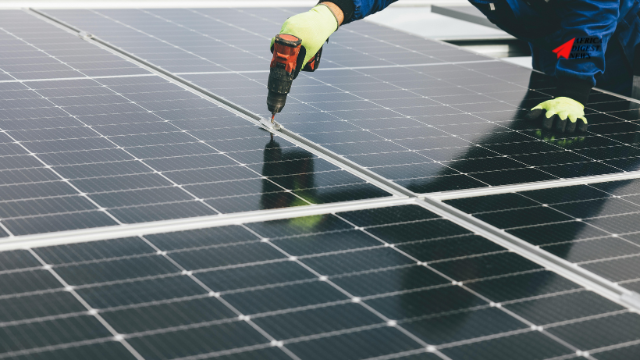
The City of Ekurhuleni in Gauteng, South Africa, is adding a new source of electricity through a 25.6 MWp solar project being developed by BluEnergy and its partner IBS Crafts at the Springs Fresh Produce Market. Construction began in October 2026, with the project representing an investment of R360 million (approximately US$21.8 million). Under a 20-year power purchase agreement (PPA), the municipality will buy electricity generated by the facility without having to finance the plant’s construction upfront. The project is expected to produce around 40 GWh annually, equivalent to the electricity consumption of approximately 6,000 average households. Its significance extends beyond renewable energy: it demonstrates how municipalities can bring private developers into electricity procurement while retaining responsibility for serving consumers.
The arrangement comes as South African municipalities seek greater control over their electricity supply amid persistent concerns about energy costs, supply reliability and dependence on Eskom, the state-owned utility. Changes to the electricity market have opened opportunities for municipalities to procure power from independent power producers (IPPs), rather than relying exclusively on electricity purchased from Eskom. Ekurhuleni’s independent power producer programme provides a framework for bringing privately financed generation into the municipal supply system.
The city has indicated that the programme could accommodate up to 2,400 MW of electricity procurement from independent producers, although this represents a programme-wide opportunity rather than capacity already contracted or operational. The policy shift is important because it creates a route for private investment into local electricity supply without requiring municipalities to fund every generating asset themselves.
For BluEnergy, the project also marks an expansion from electricity-related services into generation. Its parent company, Blu Label Unlimited, has an established presence in municipal electricity vending and revenue-assurance systems through its Cigicell business, whose systems the group says serve more than 95 municipalities across South Africa. The solar investment extends that relationship with local government into physical energy infrastructure. The commercial model is straightforward: the developer finances and builds the plant, while the municipality commits to purchasing its electricity over an agreed period.
A long-term PPA gives the developer a defined buyer for its output and a contractual basis for recovering its investment. For the municipality, the model avoids an upfront construction bill, but it creates a long-term purchasing obligation whose value depends on the agreed tariff, the plant’s performance and the cost of alternative electricity sources.
The project will use rooftop space at the Springs Fresh Produce Market alongside unused land near the facility, turning existing urban property into an electricity-generating asset. Once operational, it is expected to avoid approximately 36,000 tonnes of carbon dioxide emissions annually and create more than 100 jobs during construction. However, the practical value of the additional capacity will depend on successful grid integration and the electricity the plant actually delivers.
Read Also: Egypt’s Solar Pipeline Expands With Financing for 1.1 GW Power Project
Solar generation varies with daylight and weather conditions, meaning the project will complement rather than independently guarantee continuous electricity supply. Its connection to the Springs Bulk Substation will link the new generation to the municipal electricity network, while the city’s broader supply requirements will continue to depend on other generating sources and the functioning of the wider grid.
The wider question is whether this model can be replicated at sufficient scale to change how South African municipalities secure electricity. Ekurhuleni’s programme provides a potential route for additional private investment, while BluEnergy’s project offers a concrete example of that approach moving into construction. Yet one project cannot establish the financial or operational success of an entire procurement model. Municipalities must assess contracted electricity prices, payment obligations, grid access and the reliability of developers before committing to long-term agreements.
Developers, meanwhile, need bankable contracts and predictable regulatory arrangements to attract capital into new projects. If these conditions hold, municipal procurement could become an important additional channel for renewable energy investment in South Africa. The measure of success will ultimately be not the number of projects announced, but how much dependable electricity they deliver and whether municipalities can secure it on commercially sustainable terms.


