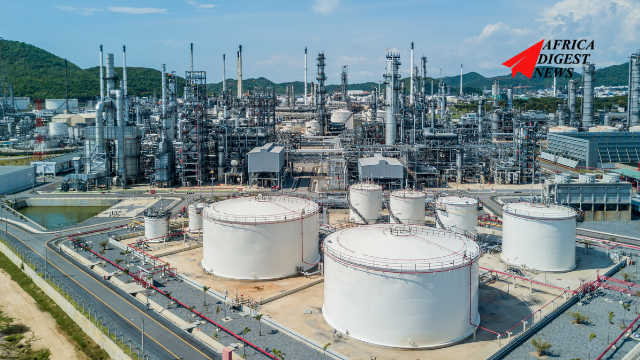
Dangote Industries Limited has selected Lamu, on Kenya’s coast, for its $17 billion East Africa refinery. The plant will process 700,000 barrels per day (bpd) and is expected to be built in around 30 months. Edwin Devakumar, Dangote’s vice president for oil and gas, confirmed the location. The decision came after talks with President Samia Suluhu Hassan in Tanzania, where Dangote explained the commercial and technical reasons for choosing Lamu. This is a construction decision and not a feasibility study.
The refinery will be built on a dedicated site in Lamu, part of the LAPSSET corridor (Lamu Port–South Sudan–Ethiopia Transport). The project is structured to:
- Serve the 8 East African countries: Kenya, Uganda, Tanzania, Rwanda, Burundi, DRC, South Sudan, Ethiopia, plus Somalia
- Process crude that can be shipped to Lamu’s deep‑water port
- Reduce East Africa’s reliance on imported refined fuel
- Create thousands of jobs in construction, operation, and logistics
The scale is comparable to Dangote’s existing complex in Nigeria, but targeted at the regional market rather than the Nigerian domestic market.
The 700,000 bpd capacity is larger than East Africa’s total refined product consumption (around 450,000 bpd). This means the refinery will:
- Provide enough fuel for the entire region
- Have about 200,000 bpd spare for export
- Allow the region to stop importing fuel from the Middle East and other sources
The LAPSSET corridor is designed to link Lamu Port to South Sudan, Ethiopia, and other markets via pipelines. This is not a “Kenya refinery.” It is a regional refinery that uses Kenya’s port and pipeline network as a hub. The effect is that fuel can be produced locally, distributed via pipelines, and sold at lower cost than imports.
East Africa spends around $20 billion a year importing fuel it already has underground. The Dangote refinery is a direct response to this. It turns the region from a fuel importer into a fuel producer, using:
- Local crude (where available)
- Regional pipelines to move fuel to markets
- A private, large‑scale operator to manage the unit
The refinery is not dependent on Kenya’s own oil production. It will process crude from multiple sources, including imports, and then distribute refined products to the region. This changes the relationship between government planning and private capital. The government sets the corridor and the rules; Dangote brings the money, the technology, and the execution.
Crude Cost and Logistics
The refinery will need crude from multiple sources, not just local production. The key economic factors are:
- Crude price: Brent or a regional benchmark, adjusted for quality differentials
- Transport costs: from oilfields or ports to Lamu, via pipeline, rail, or ship
- Port capabilities: Lamu’s deep‑water port can handle large crude carriers, reducing per‑barrel cost compared to Mombasa
If the cost of crude at the refinery gate is competitive with the price of imported refined products, the refinery can undercut imports and still earn a margin. The export surplus then becomes the source of additional profit. If crude is too expensive or logistics are too high, the margin shrinks and the export surplus may be uneconomic.
Product Price Competitiveness
The refinery must be able to sell products at prices that:
- Beat landed import costs (including freight, margins, wharfage, pipeline tariffs, and road transport)
- Allow a margin for the refinery investor
The 200,000 bpd export surplus is viable only if the ex‑refinery product price is competitive. If the refinery cannot undercut imports, the local market will not buy, and the surplus will be stranded. The export stream is then the only way to make the project profitable, and it must be structured to cover all costs and still earn a return.
Local Crude: Kenya, South Sudan, Ethiopia
Local crude is the anchor for the business case. The key sources are:
- Kenya’s Turkana oilfields (Lokichar area), which have shipped test cargoes of low‑sulphur crude and are expected to produce at commercial scale
- South Sudan’s oil production, which has been linked to a planned export pipeline to Lamu with a capacity of around 500,000 bpd
- Potential future Ethiopian crude, if domestic production grows
Logistics and Port Capability
Lamu’s deep‑water port is a key enabler. It can:
- Handle large crude carriers (Post‑Panamax, up to 21 m draft at high tide)
- Receive direct shipments from global sources
- Serve as a hub for regional crude from South Sudan and Kenya
The LAPSSET pipeline network will carry crude from South Sudan and Kenya to Lamu, reducing the need for road or rail transport. This lowers logistics costs and increases the volume of local crude that can be processed. The refinery’s location is designed to integrate with this infrastructure.
Practical Sourcing Strategy
The crude sourcing strategy for the 700,000 bpd Lamu refinery is:
- Use local crude as the anchor (Kenya, South Sudan, and potentially Ethiopia)
- Add regional crude cargoes from adjacent ports to balance the mix
- Import global crude to hedge against regional supply shocks and to access favorable price differentials
- Use Lamu’s deep‑water port and the LAPSSET pipeline network to reduce logistics costs
This mix is designed to keep the cost of crude at the refinery gate competitive, while ensuring that the refinery can process a range of crude qualities. The result is a business case that is robust to price shocks, supply disruptions, and market changes.