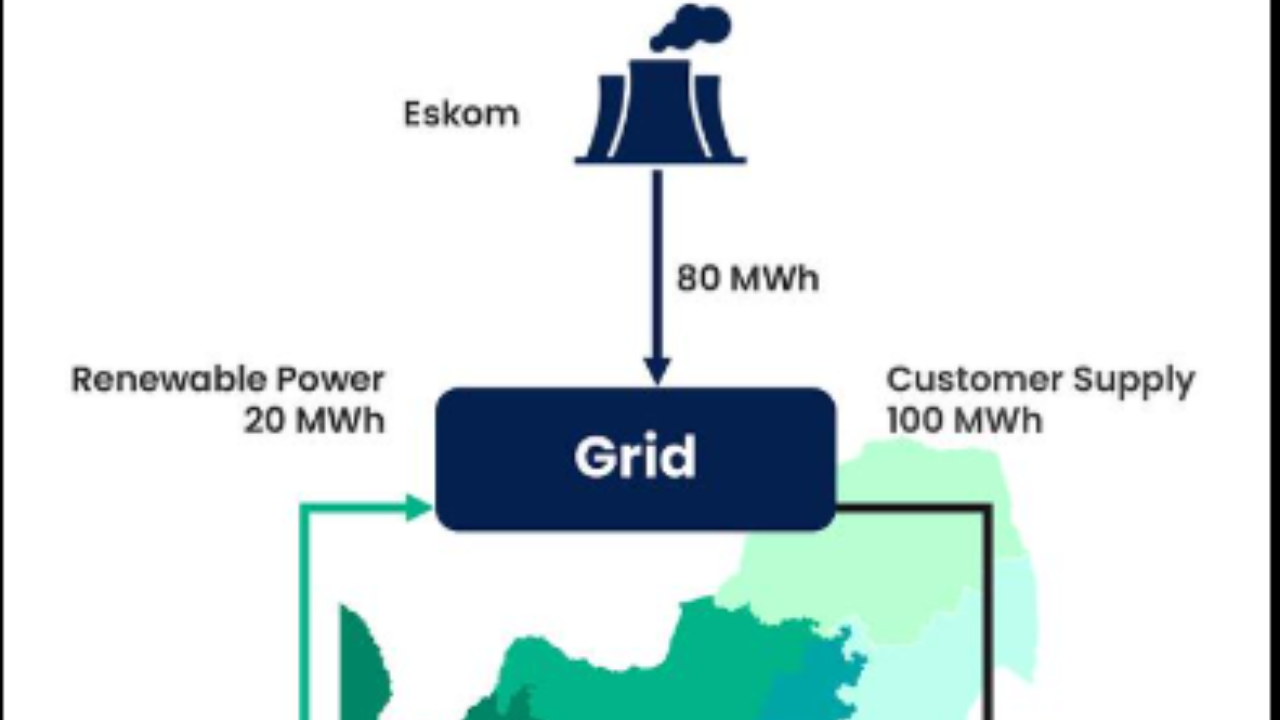
South Africa’s electricity market is changing, and one of the most important new mechanisms is energy wheeling. In simple terms, wheeling allows a company to buy electricity from a generator located somewhere else and receive that power through Eskom’s or a municipal grid. The key idea is that the electricity and the commercial contract are treated separately. The power flows through the network, while the buyer and seller settle the transaction financially. Eskom wheeling overview
The simplest way to think about it
A remote solar or wind plant injects electricity into the grid. The customer consumes electricity at its own premises, possibly hundreds of kilometers away. Eskom or the municipality measures both points and settles the energy delivered.
The buyer pays two different parties:
- the generator for the electricity itself, and
- the network owner for transporting that electricity across the grid.
Step-by-step
- Generator produces power
A solar or wind plant generates electricity and exports it to the grid.
2. Electricity enters the network
Eskom or a municipal utility carries the electricity through transmission and distribution lines.
3. Customer consumes electricity
The customer draws electricity at its own site, such as a mine, factory, office park, or shopping center.
4. Meters reconcile the transaction
Metering systems compare energy injected and energy consumed.
5. Financial settlement occurs
The buyer pays the generator under the power purchase agreement and pays wheeling charges to the network owner. Eskom wheeling framework
A real-world example
Imagine a mining company in Gauteng signs a long-term solar PPA with a developer in the Northern Cape.
Solar plant (Northern Cape)
Eskom transmission grid
Mine (Gauteng)
The mine does not need the solar farm next door. The grid acts as the delivery route, while the PPA determines the price and contract terms.
What appears on the bill?
| Charge | Paid to |
|---|---|
| Electricity purchased under the PPA | Generator |
| Wheeling / network charge | Eskom or municipality |
| Any additional grid electricity used | Eskom or municipality |
This is why wheeling is not free transport. It is a regulated network service with metering and settlement rules. City of Cape Town wheeling rules
Why companies are using wheeling
- Access renewable energy without building a large on-site plant.
- Lock in long-term electricity prices through private PPAs.
- Reduce exposure to Eskom tariff increases.
- Meet corporate decarbonization targets.
- Procure power from the best solar or wind resource areas in the country. Eskom wheeling overview
Large miners, manufacturers, retailers, and property groups are among the fastest-growing users of wheeled renewable power.
Read Also: Egypt and UK Expand Renewable Energy Partnership to Support Grid Modernization
Why this matters for solar and battery projects
Wheeling allows developers to build projects where solar irradiation and land availability are strongest, such as the Northern Cape, and sell the electricity to customers elsewhere. When batteries are added, developers can offer more reliable supply profiles while still delivering power through the existing grid.