A new solar-powered borehole in Perkerra Ward, Baringo County is demonstrating how renewable energy can solve one of rural Kenya’s biggest challenges: reliable access to clean water. By replacing an expensive diesel-powered pumping system, the project now provides a stable water supply to more than 500 households while significantly reducing operating costs.
What the project is
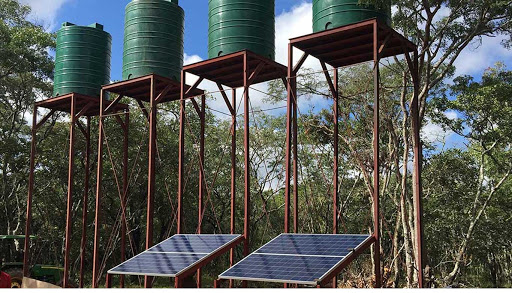
The project centres on the Toniok Borehole, which has been upgraded with a solar-powered pumping system.
The infrastructure includes:
- a solar-powered water pump,
- a 9-metre elevated water tower,
- and two 10,000-litre storage tanks, providing 20,000 litres of storage capacity.
The project was funded by the Embassy of the Kingdom of the Netherlands through the Catchment to Tap (C2T) programme and implemented by WWF-Kenya together with partners including World Waternet, Vitens Evides International, Egerton University, and KEWASNET. The Toniok installation cost approximately KSh 2.5 million, forming part of a wider KSh 8.8 million grant supporting water resource management in the area. Previously, the community depended on a diesel-powered borehole that was costly to operate and frequently unavailable because fuel could not always be purchased. The result was unreliable water access and recurring shortages.
By switching to solar power, the operating costs fall dramatically because sunlight replaces diesel as the primary energy source. That makes continuous water pumping financially sustainable while reducing maintenance associated with diesel engines. Instead of spending scarce resources on fuel, communities can focus on maintaining the water infrastructure itself.
Although solar powers the system, the real outcome is improved water security. Reliable pumping means households spend less time searching for water, agriculture becomes easier to support, and local livelihoods become more resilient, particularly in Baringo’s semi-arid environment where water scarcity is a recurring challenge. In this sense, the project is as much a water infrastructure investment as it is a renewable energy project.
The Toniok project also reflects a broader trend across Baringo County. County officials are working to solarise boreholes, replacing diesel-powered systems with renewable alternatives. Currently, only about 10% of boreholes have been converted, but the county hopes to increase that share to between 30% and 50% over time.
Other projects across the region have adopted similar approaches by combining:
- solar-powered pumps,
- elevated storage tanks,
- community water kiosks,
- and, in some cases, prepaid metering systems to improve sustainability.
This suggests the model can be replicated across many rural communities facing similar water and energy challenges.
The significance is not the size of the investment but its impact. Unlike large utility-scale renewable projects measured in megawatts, community solar projects create value by reducing the operating costs of essential public services. Here, solar is enabling affordable water rather than supplying electricity to the national grid. The result is a development model where renewable energy directly improves everyday living conditions.
Read Also: South Africa Strengthens Energy Ties with China to Accelerate Eskom Green’s Renewable Push
The Baringo solar borehole shows that some of renewable energy’s greatest impacts come not from generating electricity, but from making essential services affordable and reliable. By replacing diesel with solar, the project has transformed water supply for more than 500 households, illustrating how distributed renewable energy can strengthen resilience in Kenya’s arid and semi-arid counties.