Africa’s electricity systems were built around rivers. Africa’s future electricity systems are increasingly being built around sunlight. This is not a competition between old and new technologies. It is a conversation about infrastructure decisions that will shape economies for decades.
Hydropower has dominated African electricity generation for generations. Countries such as Ethiopia, Zambia, Uganda and the Democratic Republic of Congo built significant portions of their grids around dams and river systems. Across the continent, hydropower still accounts for a substantial share of renewable electricity generation.
But something is changing. Solar is moving faster.
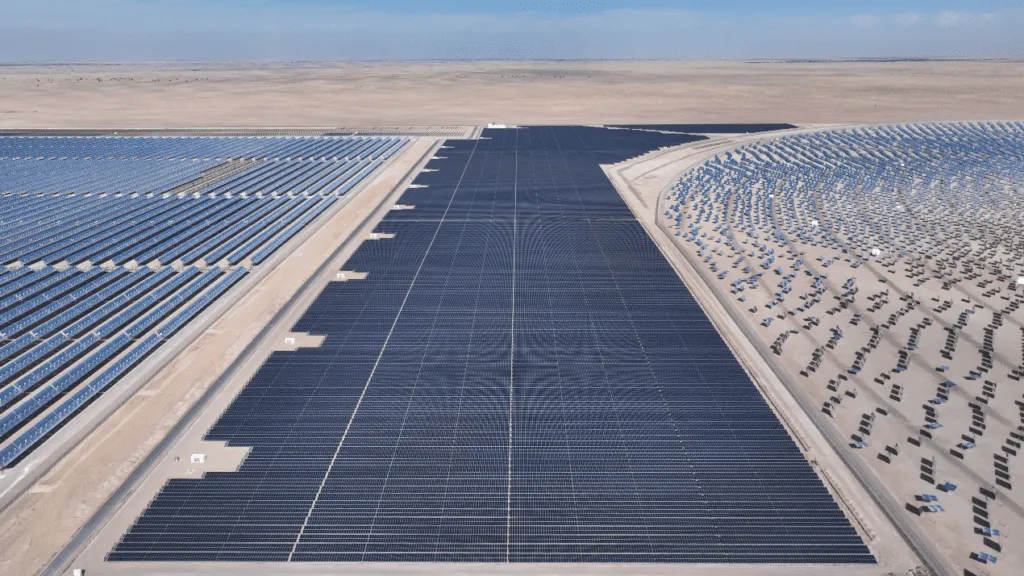
Projects that once took ten years to build can now be deployed in eighteen months. Electricity that once depended entirely on centralized grids is increasingly being generated on factory rooftops, farms, schools and industrial parks. Solar installations across Africa have accelerated significantly over the last few years as costs continue to fall and battery adoption grows.
The question is where each technology makes economic sense.
Hydropower: The Infrastructure Africa Already Knows
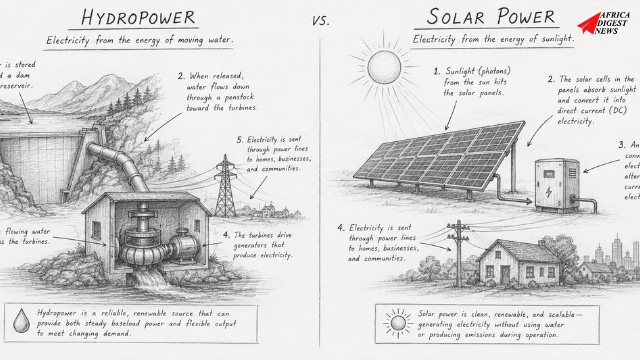
Hydropower converts the energy of flowing water into electricity. Water passes through turbines connected to generators and power is transmitted to national grids.
The concept is simple. The infrastructure is not. Building a dam can take a decade or more. It requires environmental studies, billions of dollars in financing, complex engineering and, in many cases, relocation of communities.
Yet hydropower has one advantage that few renewable technologies can match. Consistency. Unlike solar, hydropower can generate electricity day and night.
Advantages include:
- Large electricity output
- Long asset lifespan
- Stable generation
- Strong support for national grids
Challenges include:
- High construction costs
- Long development periods
- Environmental concerns
- Exposure to changing rainfall patterns
Climate variability is becoming a serious concern. Several countries in Southern Africa have already experienced electricity shortages linked to drought conditions and lower dam water levels. That introduces a new type of risk. Water is no longer guaranteed.
Solar Power: Africa’s Fastest Growing Energy Opportunity
Solar works differently. Instead of waiting for billion-dollar infrastructure projects, solar can be deployed in stages. One panel becomes ten. Ten become one hundred. One hundred becomes a solar farm. This flexibility is changing how energy systems are designed.
Solar can power a single home in Turkana, a tea factory in Kericho or an industrial park in Egypt. The deployment model is fundamentally different.
Advantages include:
- Faster installation
- Lower entry costs
- Flexible deployment
- Reduced dependence on centralized grids
Challenges include:
- Electricity production stops at night
- Weather affects generation
- Battery storage increases costs
These limitations are becoming easier to manage as battery technology becomes cheaper and more accessible. Across Africa, battery storage is increasingly being paired with solar installations to improve reliability.
Why This Is Not An Either-Or Decision
Many discussions frame hydropower and solar as competitors. That is the wrong way to think about it. They solve different problems.
Hydropower is excellent for providing stable electricity to national grids. Solar is excellent for rapid deployment and decentralized energy access. Increasingly, the two technologies are becoming partners. Hydropower can help stabilize electricity systems when solar production falls.
Solar can reduce pressure on dams during drought periods. Some researchers are even exploring floating solar panels on existing reservoirs. Studies suggest covering a small portion of Africa’s hydropower reservoirs with floating solar could dramatically increase electricity generation while reducing water evaporation losses. That combination may become one of the continent’s most valuable energy strategies.
Which One Makes More Sense?
The answer depends entirely on the problem being solved. If a country needs 5GW of stable electricity for industrial growth over several decades, hydropower remains important. If a factory needs reliable electricity within twelve months, solar is often the obvious choice.
If a rural community is waiting for grid expansion, solar may arrive years earlier. The energy transition is forcing governments to abandon a dangerous habit. Thinking in singular solutions. No country will build its future on one technology. The winners will build portfolios.
Solar. Hydropower. Wind. Geothermal. Battery storage. Each technology will occupy a different role inside the same system. That may ultimately be the biggest shift taking place across Africa’s energy sector. The future of electricity will not be built around one source of power. It will be built around how intelligently countries combine multiple sources together.