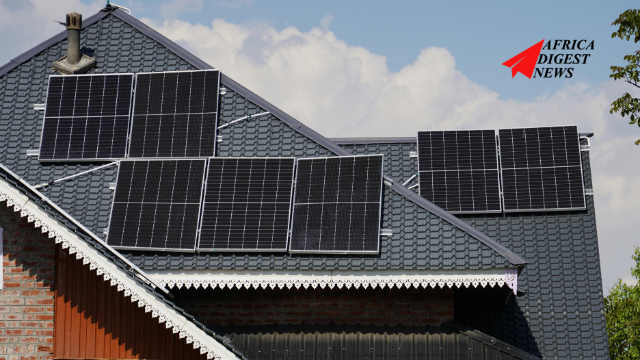
Kenya Power is facing a growing challenge from a technology that is simultaneously reducing electricity costs for businesses and weakening the utility’s traditional revenue model: rooftop solar. The pressure is particularly significant in the commercial and industrial (C&I) market, where large electricity users account for a disproportionate share of Kenya Power’s sales revenue. As factories, warehouses, shopping centres and other large consumers install their own solar systems or sign long-term solar power purchase agreements, they can reduce the amount of electricity they buy from the grid while continuing to rely on Kenya Power for backup and network services.
That creates a difficult economics problem for the utility: the customer’s electricity consumption falls, but much of the infrastructure needed to serve that customer remains. Industrial consumers have historically been among Kenya Power’s most valuable customers.
The utility has previously indicated that industrial customers account for roughly 55% of its sales revenue, despite representing a relatively small proportion of total connections. In FY2019, industrial customers consumed about 4,462 GWh, generating approximately Sh63 billion in revenue. That makes the shift towards self-generation particularly important.
When a household installs a few solar panels, the effect on Kenya Power’s finances is relatively limited. When a large factory replaces a substantial portion of its daytime grid consumption with solar, the impact is much greater.
The economics are increasingly favouring solar. C&I electricity tariffs can be significantly higher than the long-term cost of electricity generated by large rooftop or captive solar installations. Industry estimates put typical C&I grid electricity costs at around Sh22–25 per kWh, while solar PPAs and self-generation can potentially deliver electricity at around Sh5–8 per kWh, depending on the project and financing structure. For an electricity-intensive factory, the difference can translate into substantial savings over the life of a solar installation. The incentive is therefore straightforward: buy less expensive electricity from the grid and generate more of your own.
Solar does not eliminate the need for the electricity network. A factory may still require Kenya Power’s connection when its solar system is not producing enough electricity, particularly at night, during periods of poor weather or when demand exceeds onsite generation. The utility must consequently continue maintaining transmission and distribution infrastructure, system capacity and backup arrangements.
But its revenue from selling electricity to that customer falls. This creates what has become one of the central challenges for traditional utilities facing distributed generation: they can lose energy sales faster than they can reduce the costs associated with serving the customer. As electricity sales decline while many system costs remain relatively fixed, the cost of serving each remaining unit of electricity can increase.
Rooftop solar is not the only challenge. Kenya’s evolving electricity market is also opening the door to greater competition for large consumers. Under the Energy (Electricity Market, Bulk Supply and Open Access) Regulations 2026, licensed generators can sell electricity directly to eligible large consumers, with the existing network potentially being used to deliver that power for a wheeling charge.
That changes the role Kenya Power plays in the transaction. Instead of purchasing electricity from Kenya Power, a large industrial customer could potentially enter into a power purchase agreement directly with a renewable-energy producer and pay Kenya Power primarily for access to its network. For the utility, that means moving from being the supplier of electricity to increasingly becoming the operator of the infrastructure through which electricity moves.
Read Also: How One 50 MW Solar Plant Shows South Africa’s Power Market Is Changing
The utility has previously explored ways of participating directly in the C&I solar market rather than simply watching customers leave. One approach has involved installing and operating solar systems for large customers and selling the resulting electricity at a discounted rate. The logic is simple: if customers are going to switch to solar anyway, Kenya Power has an incentive to sell them the solar itself.
The utility has also pushed for tariff structures that better reflect the fixed costs of maintaining the electricity system as customers generate more of their own power. That debate is becoming increasingly important as Kenya moves towards a more decentralised electricity system.
The growth of C&I solar does not necessarily mean Kenya Power will lose these customers completely. It does, however, challenge the economics of the traditional utility model. For decades, the basic relationship was straightforward: Kenya Power builds and maintains the network → customers buy electricity → the utility earns revenue from electricity sales.
Distributed solar changes that relationship. A factory can generate some of its own electricity. A solar developer can sell directly to the factory. And Kenya Power can increasingly earn revenue simply for providing the network that connects the two. That could eventually make wheeling, network services, balancing and other system services more important sources of revenue. For now, however, those businesses remain much smaller than the electricity sales being displaced.